Why Policy Version Control Is Not Optional
Here’s a scenario that plays out more often than it should: An auditor asks what your Acceptable Use Policy said on a specific date last year. It’s relevant because there was a user incident during that period, and the question is whether the employee violated a policy that was actually in effect at the time.
You go looking. Maybe you find the current version of the policy — but was it the same version in effect a year ago? Has it been updated since? If it has, where’s the old version? Who approved the change? When exactly did it go live?
If you can’t answer those questions cleanly, you have a versioning problem.
What Version Control Actually Means for Policies
In software development, version control is table stakes. You wouldn’t ship code changes without tracking what changed, who changed it, and why. Policy management deserves the same rigor, but most organizations treat policies more like living documents in a shared folder — updated in place, with no history.
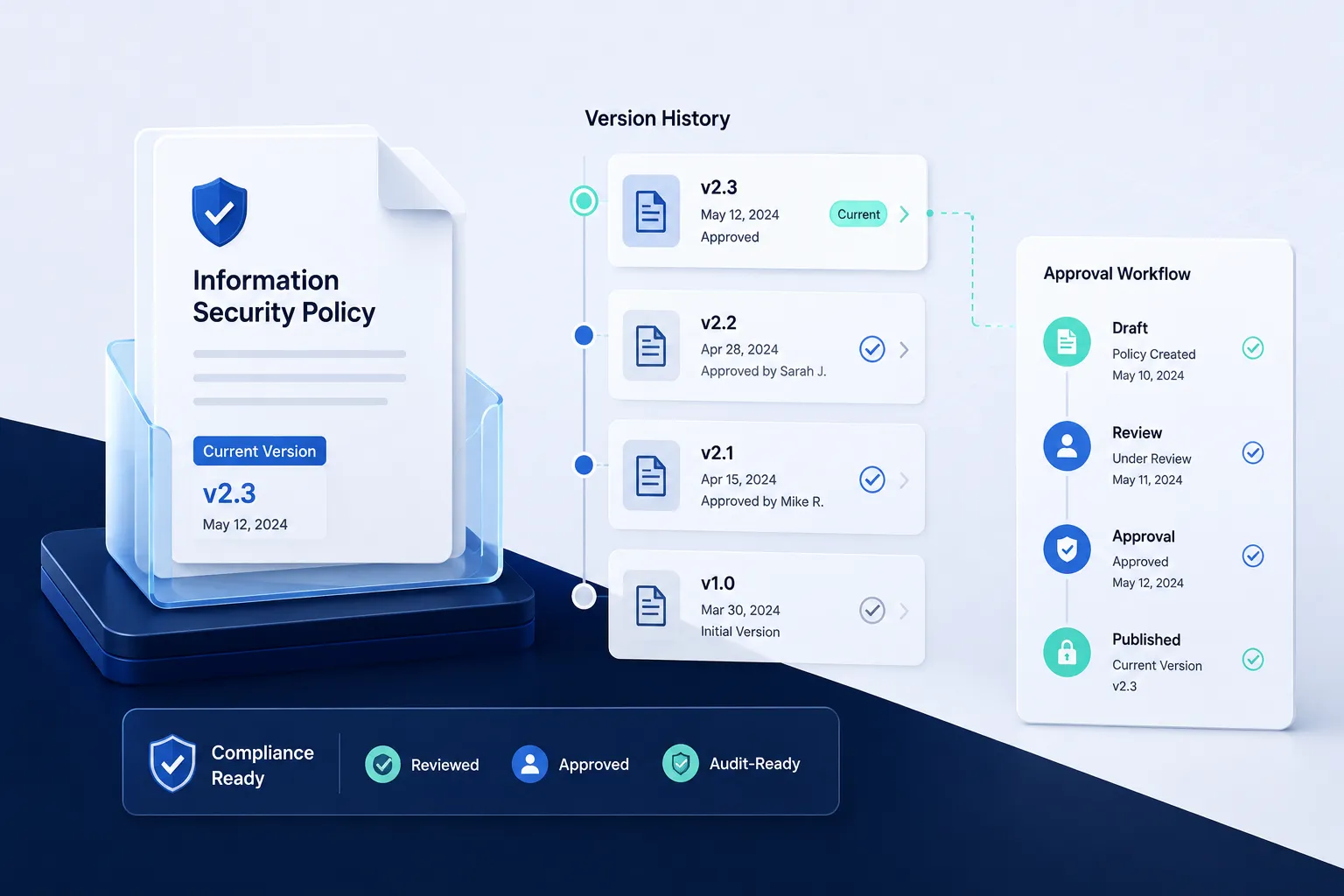
Good policy version control tracks:
- What changed between versions — ideally at the text level, not just “policy updated”
- Who authored and approved each version
- When it became effective — the approval date and the effective date can be different
- What version was current on any given date in the past
That last point is often overlooked. It’s not enough to have the current version and a vague sense of “we updated this recently.” Compliance often requires proving what policy was in effect at a specific historical point in time.
The Approval Chain Matters Too
Version control without approval records is incomplete. For regulated industries, having a policy change without documented approval by the appropriate authority is itself a finding.
Every version should have a clear answer to: Who reviewed this? Who approved it? What was the approval date? Were any approvals declined or sent back for revision?
This is especially important for frameworks like CMMC and NIST that have explicit requirements around policy review and approval. When an assessor reviews your access control policy, they’re going to want to see not just the document itself but evidence that it was reviewed, approved, and current.
Acknowledgment Tracking Closes the Loop
Here’s the part that’s easy to skip: even after a policy is approved and published, you need evidence that the right people actually received and read it.
“We posted it on the intranet” is not acknowledgment. “User X confirmed they read version 2.1 of the Acceptable Use Policy on March 14, 2026 via electronic signature” is acknowledgment. That’s the level of specificity auditors expect.
For compliance frameworks that require employees to be aware of specific policies, acknowledgment records are direct evidence. Without them, you’re claiming the control is met without being able to prove it.
Building a Practical Version Control Process
You don’t need a complex system to do this well. The fundamentals:
-
Never edit a policy in place. Always create a new version. This sounds simple, but it requires discipline when someone spots a typo and just wants to fix it.
-
Keep a version log. At minimum: version number, effective date, summary of changes, author, approver.
-
Lock approved versions. Once a policy version is approved and effective, it should not be editable. Changes require a new version.
-
Set review cycles and track them. Policies that haven’t been reviewed in two years raise questions. Document your review cadence and follow it.
-
Track acknowledgments. For any policy that requires employee awareness, track who signed off and when — tied to the specific version, not the policy in general.
When these habits are in place, an audit question about policy history becomes a 30-second lookup rather than a stressful investigation. That’s the difference between compliance that’s built into operations and compliance that’s assembled last-minute.
The policy lifecycle isn’t glamorous, but it’s foundational. Frameworks like CMMC, NIST, and ISO all assume that your governance layer is documented, approved, and current. If your policy management process doesn’t produce clean answers to the questions auditors ask, it’s not serving its purpose.
Build your audit-ready proof with Proofyx
Automate evidence collection and policy management — always prepared for your next audit.
Proofyx Editorial Team
Compliance Intelligence
Expert analysis and regulatory guidance for organizations navigating modern compliance frameworks.