The Gap Between What You Say and What You Prove
There’s a persistent gap in how most organizations approach compliance. On one side, you have governance — policies, standards, and procedures that describe how the organization operates. On the other side, you have technical compliance — specific controls that need to be implemented and evidenced. Most organizations have both. Very few have explicitly connected them.
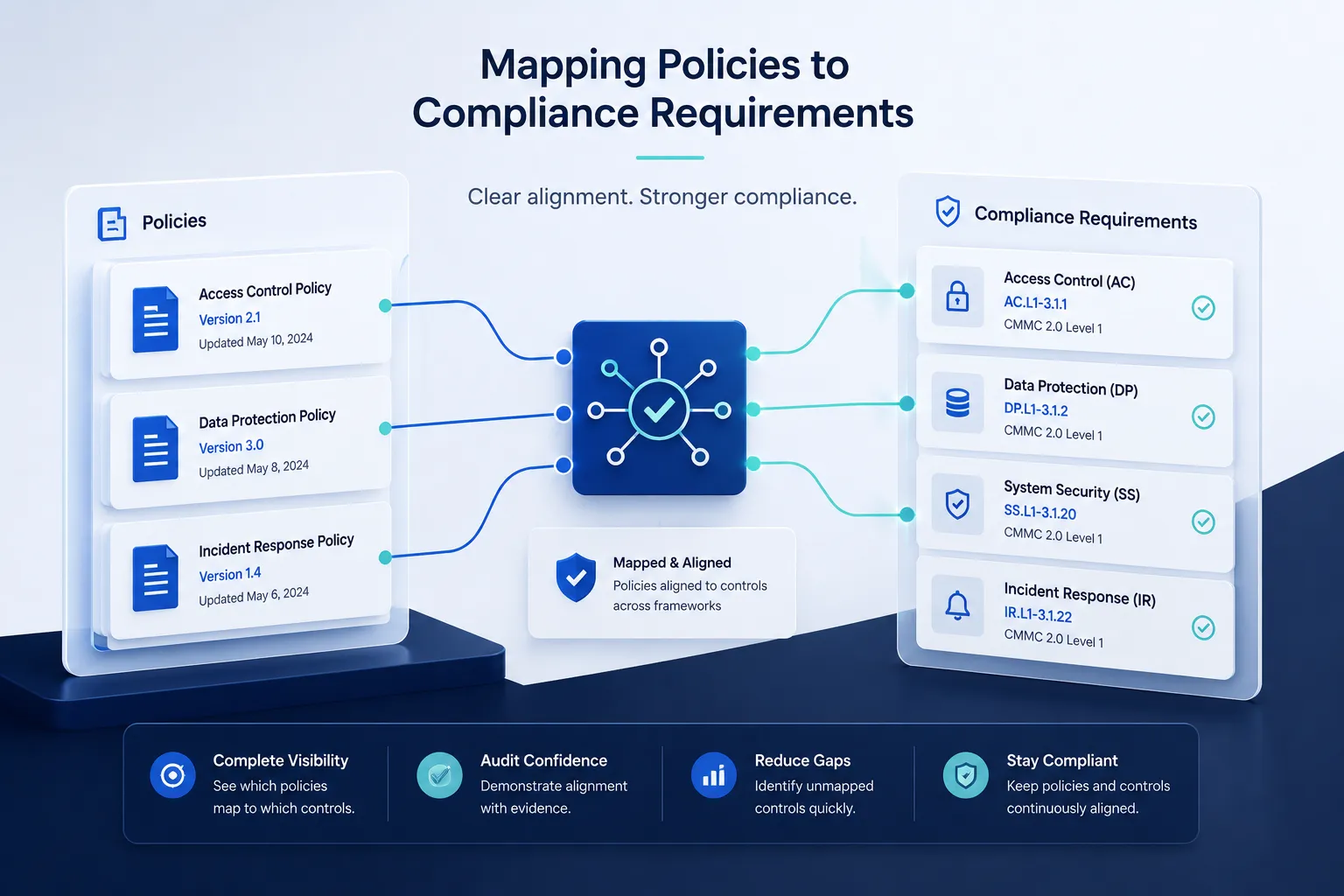
This matters because auditors don’t just evaluate your technical implementation or your policies in isolation. They want to see the chain: “Here is our policy on access control. Here is how that policy maps to CMMC AC.1.001. And here is the evidence that the policy is being followed.”
Without that chain, a technically compliant organization can still fail an audit, and a well-documented organization can still have unexplained gaps.
Why the Mapping Problem Is Harder Than It Looks
The challenge with policy-to-control mapping is that the relationship is rarely one-to-one. A single policy — say, an Access Control Policy — might be relevant to a dozen different CMMC practices across multiple domains. Conversely, a single practice might be partially addressed by three different policies.
This means you can’t just drop your policy library into a framework spreadsheet and call it done. You need to think through each control and ask: “What in our governance layer actually speaks to this? And is what we’ve documented sufficient to demonstrate that this control is met?”
Sometimes the honest answer is: we have the technical control in place, but we don’t have a policy that describes it. That’s actually a common finding — organizations implement security measures operationally without ever formalizing them in governance documents. Both need to exist.
A Practical Mapping Approach
Start with the framework, not your policy library. Take each practice or control and work through three questions:
1. Do we have a policy that addresses this? If not, you have a gap in your governance layer, not just a documentation issue. The policy needs to exist, be approved, and be current.
2. Does the policy say what it needs to say? A policy that vaguely references “appropriate access controls” doesn’t clearly satisfy AC.1.001. Review whether your policies have enough specificity to be useful as governance documents and as audit evidence.
3. Is there evidence that the policy is being followed? This is where most organizations have the biggest gap. You can have excellent policies and still have no proof that they’re implemented. Evidence should be mapped alongside the policy, not treated as a separate workstream.
What Good Mapping Documentation Looks Like
For each control in your target framework, you should be able to point to:
- The policy or policies that establish the governance requirement
- The technical implementation that fulfills the control (system configurations, tools, processes)
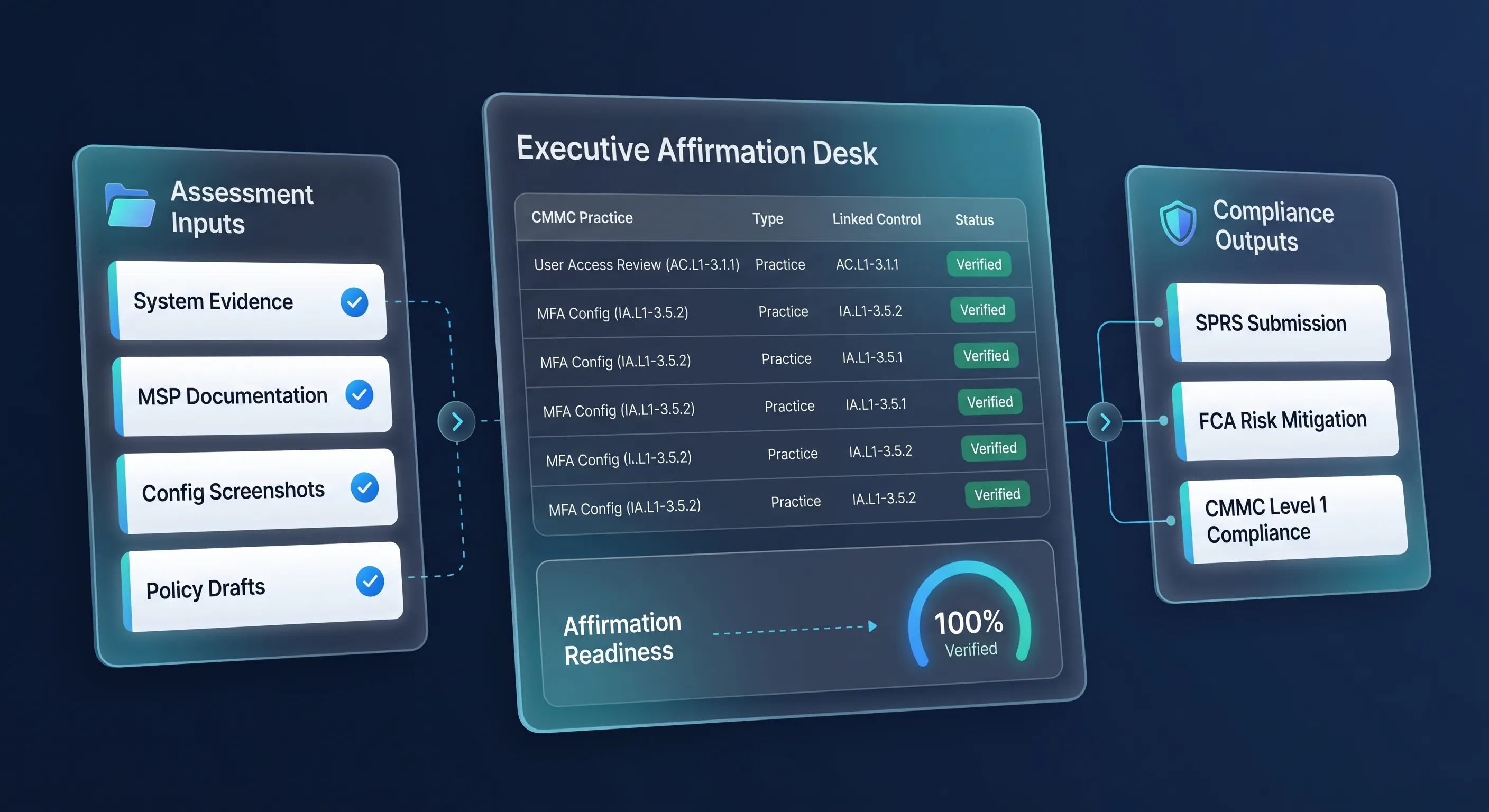
- The evidence that the implementation is real and current
- The owner responsible for maintaining this control
When this is documented clearly, an audit becomes a structured walkthrough rather than a reactive hunt for information.
Keeping the Map Current
Compliance mapping isn’t a one-time project. Every time your organization changes — new systems, acquisitions, employee turnover, framework updates — your map needs to be reviewed.
A common failure mode: a policy is updated to reflect a new process, but the framework mapping isn’t updated to reflect the change. Now the policy says one thing, the controls reference an old process, and the evidence is inconsistent. This creates unnecessary audit findings that have nothing to do with your actual security posture.
Build mapping reviews into your change management process. When a policy changes, review what it’s mapped to. When a framework is updated (as CMMC has been, and will be again), review which of your policies need to be updated in response.
The organizations that handle compliance mapping well treat it as a living operational artifact, not a project deliverable. The investment is in building systems where the connection between governance and proof is explicit, navigable, and always current. Everything else flows from there.
Build your audit-ready proof with Proofyx
Automate evidence collection and policy management — always prepared for your next audit.
Proofyx Editorial Team
Compliance Intelligence
Expert analysis and regulatory guidance for organizations navigating modern compliance frameworks.