Building Audit-Ready Evidence: More Than Just Having Files
If you’ve been through a compliance audit — a real one, with a third-party assessor who’s seen thousands of organizations — you know that having documentation and having good documentation are very different things.
A lot of organizations spend enormous energy creating policies and procedures, then show up to an audit with a pile of files and the assumption that quantity equals readiness. Assessors see through this quickly. What they’re actually looking for is evidence that is contextualized, timestamped, and directly traceable to a specific control.
What Makes Evidence “Audit-Ready”?
Let’s define the term. Audit-ready evidence is documentation that an independent assessor can evaluate without additional explanation from you. It should be self-contained and clear.
The four core attributes:
1. Specificity — The evidence applies to a specific control, not general “good security.” A screenshot of your login page doesn’t prove you’ve implemented MFA. A screenshot of your Azure AD MFA enrollment report, with a date, showing 100% user coverage, gets much closer.
2. Timeliness — Evidence should reflect current practices, or at minimum, the period under assessment. A password policy written three years ago that’s never been reviewed doesn’t demonstrate ongoing compliance. A policy with a recent review date, signed by an owner, does.
3. Authenticity — Evidence should come from the system of record, not a reconstructed narrative. System logs, export reports, and configuration screenshots carry more weight than someone’s written description of what they believe is configured.
4. Attribution — It should be clear who did what, and when. Evidence that shows action without a named person raises questions. A user access review signed by the IT manager on a specific date is much more useful than an undated list of usernames.
The Common Evidence Mistakes
Stacking policies instead of proof. A policy says what you’re supposed to do. Evidence shows that you’re actually doing it. Both are required. We regularly see organizations with excellent policy libraries and almost no implementation evidence — this is a significant audit risk.
Untimed screenshots. Screenshots without visible timestamps, without system-generated dates, or with cropped system clocks will be questioned. Get in the habit of capturing the full screen so the date and system context are always visible.
Evidence that covers “some” but not “all.” CMMC and NIST assessors will ask whether a control is applied to all relevant systems, all users, all locations. “We do this for most of our infrastructure” is a partial finding. Map your scope carefully and make sure your evidence reflects the full scope.
Centralization gaps. When evidence lives in 12 different places — emails, shared drives, cloud storage, someone’s laptop — it creates risk. Evidence gets lost, versions get confused, and when you need to produce something quickly, you can’t find it. One of the most practical things you can do is consolidate evidence in a single location with clear labeling.
Building an Evidence Collection Habit
The organizations that handle audits well aren’t doing a frantic sprint in the weeks before. They’ve built evidence collection into their normal operational workflows.
A few practical patterns:
- Scheduled exports. Set up monthly or quarterly automated exports of access control lists, patch status reports, vulnerability scan results. Store them automatically in your evidence repository.
- Event-driven documentation. When something happens — a policy is updated, an employee is offboarded, a system is patched — capture the evidence immediately, not weeks later.
- Evidence reviews. Quarterly, walk through your control list and verify that evidence is current. Flag anything that’s going stale before it becomes a gap.
Connecting Evidence to Controls
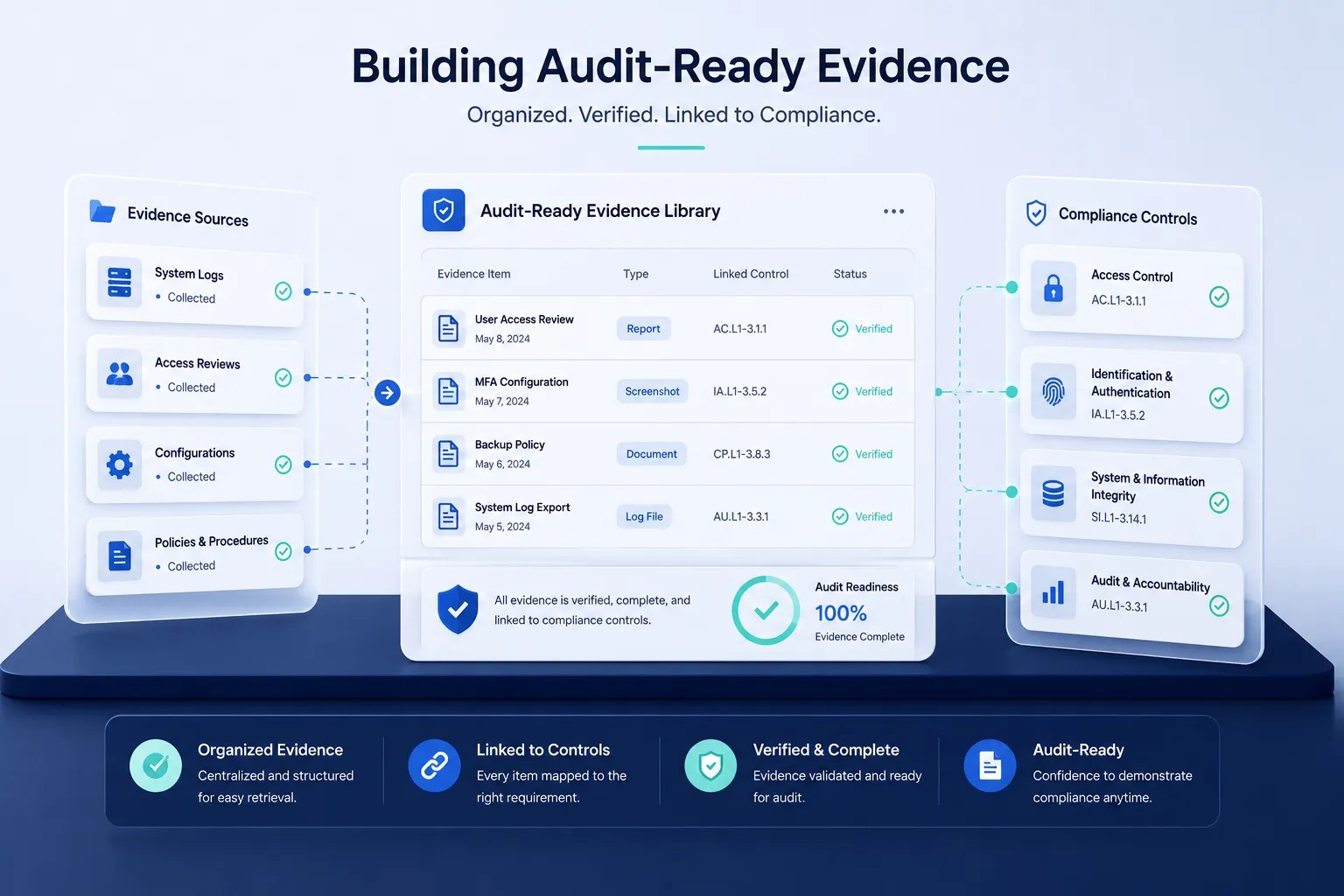
One of the most time-consuming parts of an audit is helping assessors understand which piece of evidence maps to which control. If your evidence is organized by control from the beginning, this becomes a non-issue.
When you store a piece of evidence, ask: “Which control does this support?” Label it accordingly. If a single piece of evidence supports multiple controls — which is common — reference it explicitly in each relevant location.
This is the operational shift that changes audit readiness from a project into a practice. It requires more discipline upfront, but the payoff is that your next audit looks like you’re prepared, because you are.
Evidence is what turns a compliance claim into a compliance proof. Most organizations know what they’re supposed to be doing — but the ones that demonstrate it clearly, consistently, and specifically are the ones that come out of audits with clean reports. Build that capability before someone’s asking for it.
Build your audit-ready proof with Proofyx
Automate evidence collection and policy management — always prepared for your next audit.
Proofyx Editorial Team
Compliance Intelligence
Expert analysis and regulatory guidance for organizations navigating modern compliance frameworks.