How AI Can Support Compliance Readiness (Without Replacing Accountability)
Somewhere between “AI will solve everything” and “AI is useless for serious work” is where most compliance professionals actually live. The technology is genuinely useful for certain parts of the compliance workflow. It’s also being oversold in ways that could create real risk if organizations aren’t careful about where they trust it.
Here’s a grounded take on where AI adds value in compliance readiness — and where human judgment still has to be in the loop.
Where AI Actually Helps
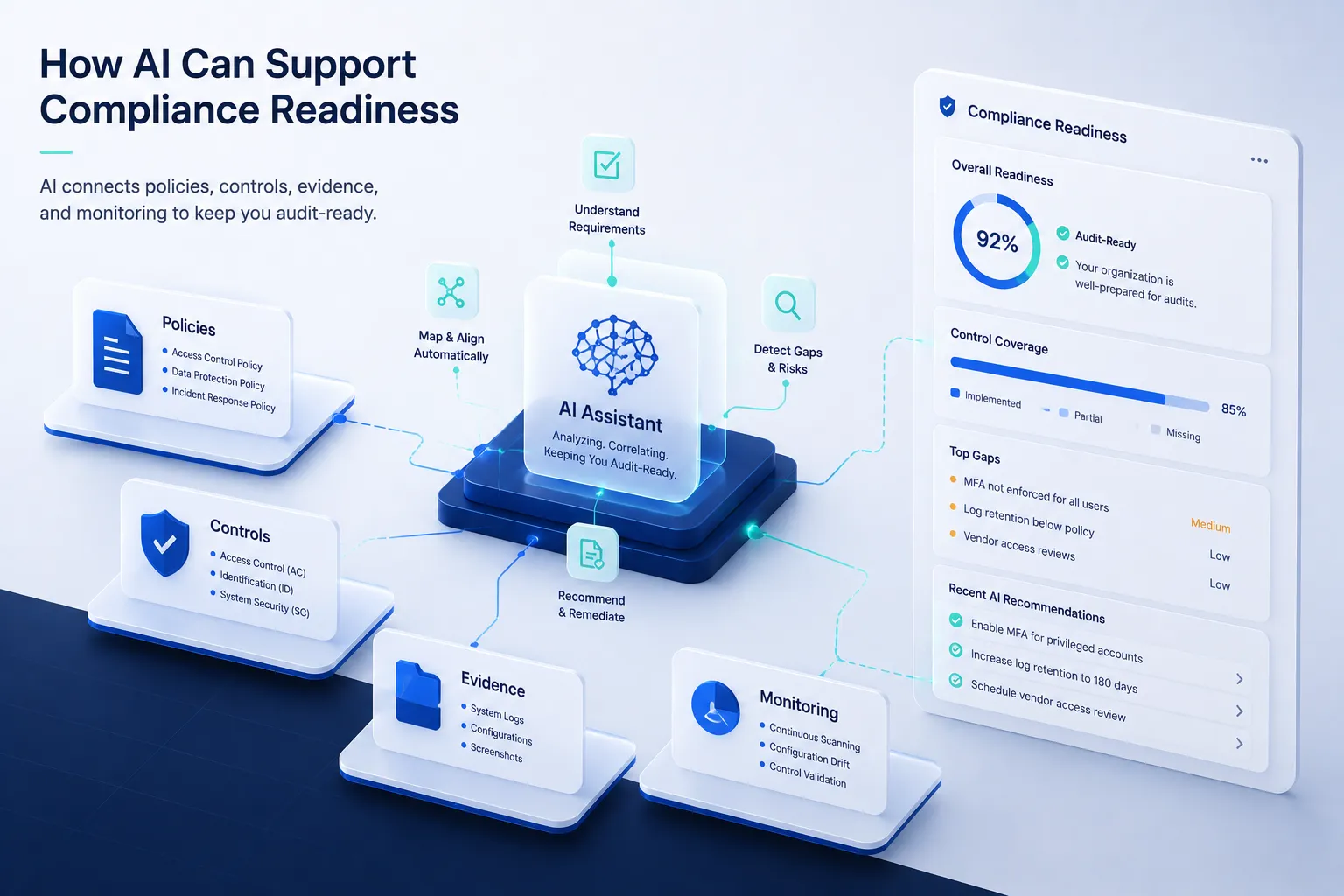
Evidence summarization and categorization. Compliance teams often accumulate large volumes of documentation — logs, screenshots, reports, policy documents — and need to match it against specific controls. AI tools are reasonably good at reading a document and suggesting which controls it might support. This doesn’t replace the review, but it significantly reduces the time spent on initial triage.
Gap identification during intake. When an organization is starting a compliance program, AI can be useful for reviewing existing documentation and flagging areas where evidence appears thin or where policy language doesn’t clearly address a specific requirement. It’s faster than manual review and catches obvious issues that humans often skim past.
Policy drafting assistance. AI language models can help draft policy language that’s appropriate for a given framework. This is legitimately time-saving — a first draft of an acceptable use policy or an incident response plan is something AI handles competently. The output still needs to be reviewed, tailored to the organization, and approved by someone accountable for it. But starting from a blank page is harder than reviewing and editing.
Status reporting and dashboard generation. If your compliance data is structured consistently, AI can be used to generate status summaries, track remediation progress, and flag controls that are approaching review dates. This is primarily a time-saving tool for compliance managers who are maintaining multiple frameworks simultaneously.
Where AI Falls Short
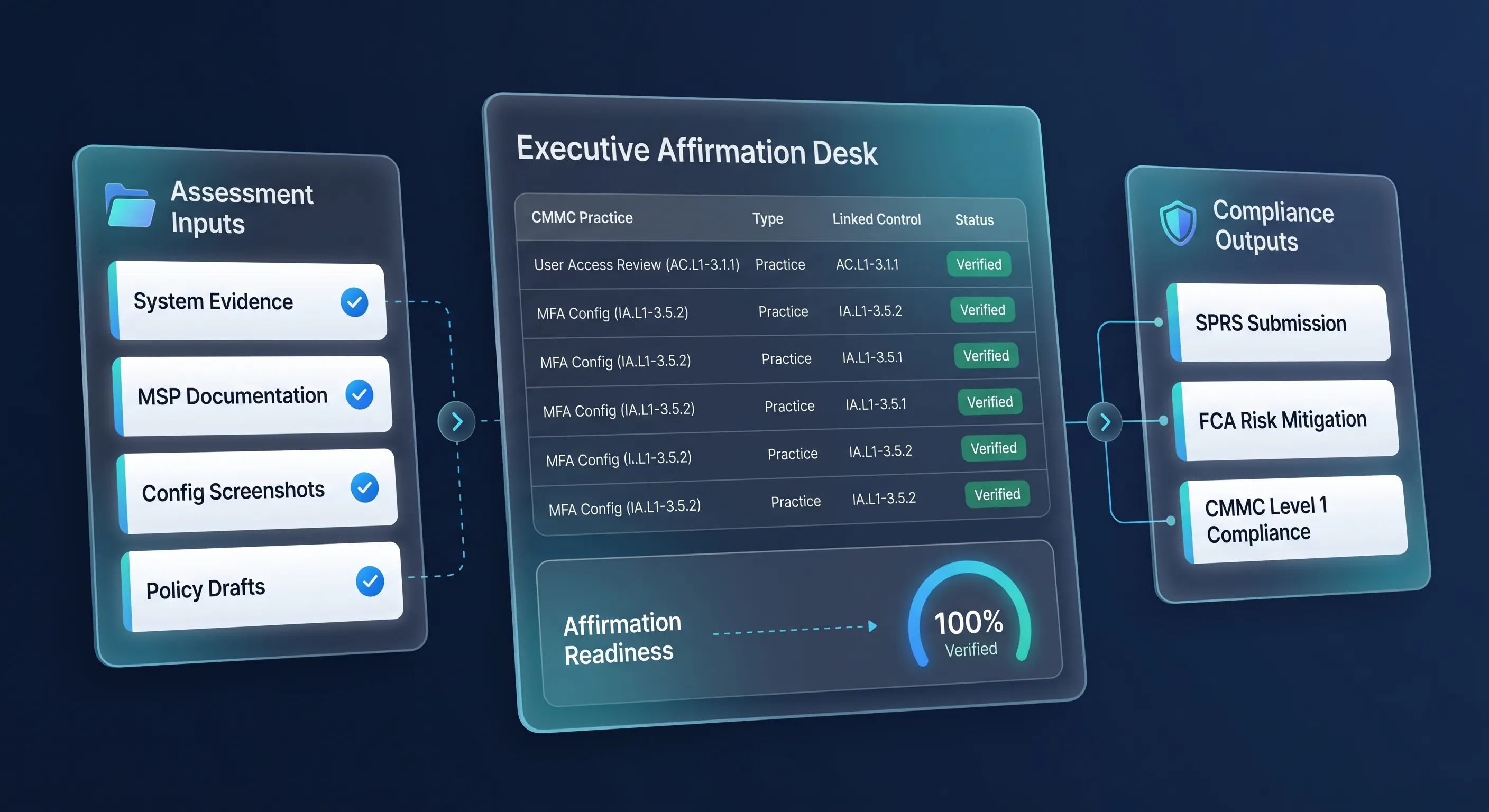
Attestation. This is the big one. Compliance isn’t just about having documentation — it’s about having someone accountable vouch for it. Under frameworks like CMMC, the organization’s leadership is signing off on the accuracy of self-assessment scores. AI can assist in building the evidence package, but the attestation has to come from a person who understands what they’re signing and accepts the legal responsibility for its accuracy.
Judgment calls on evidence quality. AI can tell you that you have a document associated with a control. It cannot reliably assess whether that document is actually sufficient to satisfy an assessor’s standards. Evidence quality is contextual and often depends on factors like scope clarity, timestamp credibility, and assessor interpretation. These are human judgment calls.
Understanding organizational context. Compliance controls are implemented in the context of specific organizational structures, systems, and business processes. AI lacks the organizational context to know whether a control that looks satisfied on paper actually reflects what’s happening operationally. A human reviewer who knows the organization can catch this; an AI reviewing the same documents often can’t.
A Useful Mental Model
Think of AI as a capable analyst who can read fast, draft well, and flag obvious gaps — but who needs to be supervised by someone who understands the stakes. The analyst shouldn’t be the one signing the SPRS submission. They shouldn’t be the final authority on whether evidence is sufficient. But they can do a lot of the preparatory work that makes the human’s time more productive.
This is roughly how compliance tools should be positioned: as a way to reduce administrative friction so that the people who are accountable can focus on the decisions that require judgment, rather than spending their time organizing files and formatting reports.
AI in compliance is not a shortcut to avoiding the hard work. The hard work — building real controls, maintaining consistent practices, documenting honestly — that’s still human work. What AI does is make the documentation and review process faster and more systematic. For compliance teams that are stretched thin, that’s a meaningful improvement. Just don’t confuse it with something more than it is.
Build your audit-ready proof with Proofyx
Automate evidence collection and policy management — always prepared for your next audit.
Proofyx Editorial Team
Compliance Intelligence
Expert analysis and regulatory guidance for organizations navigating modern compliance frameworks.